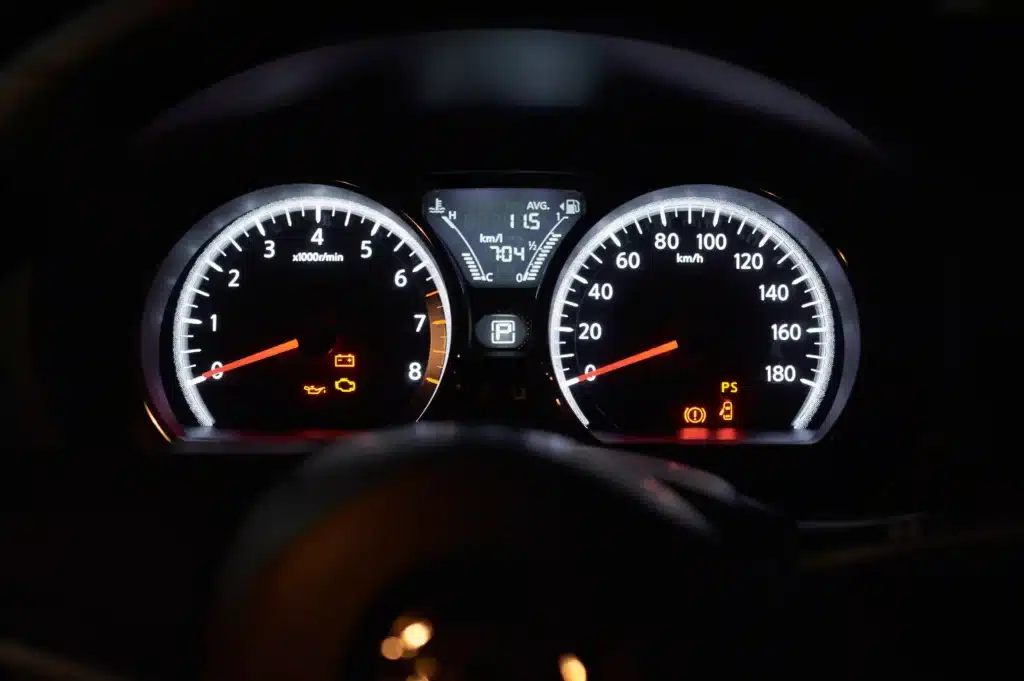

You are ten minutes into an ordinary drive when a message drops onto the cluster and the engine goes quiet under you. The words on the screen are coolant temperature high, and Jeep Compass drivers who have seen them once tend to see them a second time, usually somewhere less convenient than the first.
You coast onto the shoulder, sit for a minute, shift into park, and the SUV fires up as though nothing happened. The gauge reads normal. Days later a technician scans it, finds nothing stored, and tells you there is nothing to fix.
A warning that is deafening in the moment and invisible afterward is hard to get anyone to take seriously. Federal investigators did look at this one, and they closed the file. The word closed decides far less about the SUV in your driveway than it sounds like it should.
The Jeep Compass Warning That Cuts Power Without Overheating
The shutdown is the protection, not the breakdown. The engine control system acts on the coolant temperature value it is handed, and once that value crosses a threshold it pulls power to spare the engine. Whether the coolant was ever hot is a separate question, and on these SUVs the answer is often no.
For most owners the phrase Jeep Compass overheating does not describe what happened. The needle never climbed, the reservoir was full, and the message cleared itself somewhere between the shoulder and the service drive.
Most reports follow one shape. The SUV cuts out in slow traffic or at a light, sits for anywhere from seconds to minutes, and restarts normally once it has been shifted into park. A smaller group had to be towed, and some owners have watched the same failure return a dozen times or more, sometimes with a dead battery and a failed auto start and stop system.
Dealers reach first for the Jeep Compass coolant temperature sensor and the wiring behind it, which is a sensible place to start. Owners who have been through it will tell you a replaced part and a software update do not always end it, and that the second repair order reads much like the first.
What Federal Regulators Examined on the Compass and How It Ended
In December 2022 the National Highway Traffic Safety Administration opened a preliminary evaluation covering 228,969 Jeep Compass SUVs, model years 2019 and 2020. The subject line the agency chose was false overheat leading to loss of motive power. That wording tells you the agency already doubted the heat was real.
Investigators finished with 173 vehicles that had shut down with the coolant message showing. One crash was alleged, at a stop light, with nobody hurt and no fires anywhere in the file.
Chrysler’s answer was that a warning followed by a restart is not an unreasonable risk to anybody, and the agency did not argue with that description of what happens.
The file closed a year later with no recall ordered and nothing required of Chrysler. The failure rate was low, about nine hundredths of one percent on the older of the two model years and roughly half that on the newer one, and the vehicles could normally be restarted immediately after a shutdown.
Why the Closed Review Says Nothing About Your Compass
The closing document ends with a sentence almost nobody quotes. The agency was careful to say that shutting a file is not a ruling that nothing is wrong with the vehicle, and that it can pick the question back up whenever it wants to. Closed is not the same word as fixed, and it is not the same word as cleared.
Look at what the government was asking. Out of nearly a quarter million SUVs, are enough failing badly enough to justify a repair order covering every one? The failure rate answered that, and the answer was no.
The rate has nothing to say about your vehicle. A number that small is a rounding error to a regulator and a complete failure to the driver who owns one of the 173. Your Compass does not shut down a fraction of a percent of the time, it either does this to you or it does not.
No free federal repair is waiting at the dealership, because a recall is what creates one, and no recall has opened on this defect. What remains is the warranty you paid for, and warranty law asks a different question.
One Compass Is the Only Sample Size in a Warranty Claim
The Song-Beverly Consumer Warranty Act works from a starting point no federal defect review shares. It never asks how common a problem is across a fleet. It asks what one Compass loses when the engine takes its own power away in traffic, and whether the SUV you were sold was ever supposed to do that.
An engine that removes its own power on a public road is not a convenience item, and that safety weight shapes how a court judges what counts as a fair number of attempts. A visit that ends with a technician finding nothing stored still lands on the record as an attempt, which matters here, because that is how most of these visits end.
The money you laid out counts too. Tow bills and rental charges you covered while somebody hunted a fault that had already vanished belong in the file beside the repair orders.
A Compass that qualifies leaves Chrysler two ways out, another vehicle or the money this one cost you, and the legal bill lands on Chrysler either way. Our California lemon law guide goes into how that buyback figure is put together, and our Jeep lemon law page collects the shutdown and stalling histories owners of these SUVs report.
If the warning has come back after a dealer visit or two, start keeping the log the scan tool cannot. Write down the date, the mileage, the traffic you were sitting in, and how long the Compass stayed dead before it restarted. Those notes are worth a call to Lemon Law Help, since they turn a run of nothing found visits into a record.
Closed at the Agency, Still Open in Your Compass
Closed: the federal review. Investigators decided the shutdowns were not frequent or severe enough to order a fix for every Compass on the road, and they closed it out at the end of 2023. That was a fair answer to the question they were asking, and it was never a verdict on your vehicle.
Open: your warranty and the defect itself. The coverage that came with the Compass is what is still live here, and it runs on a clock that does not pause while a dealer hunts for a code that was never stored.
The agency kept the right to pick this back up, and a recall issued later would not erase the visits already on your record. Either way the answer is in your repair orders and not in any federal file.
Reviewed by Roger Kirnos, Managing Attorney, California State Bar No. 283163.