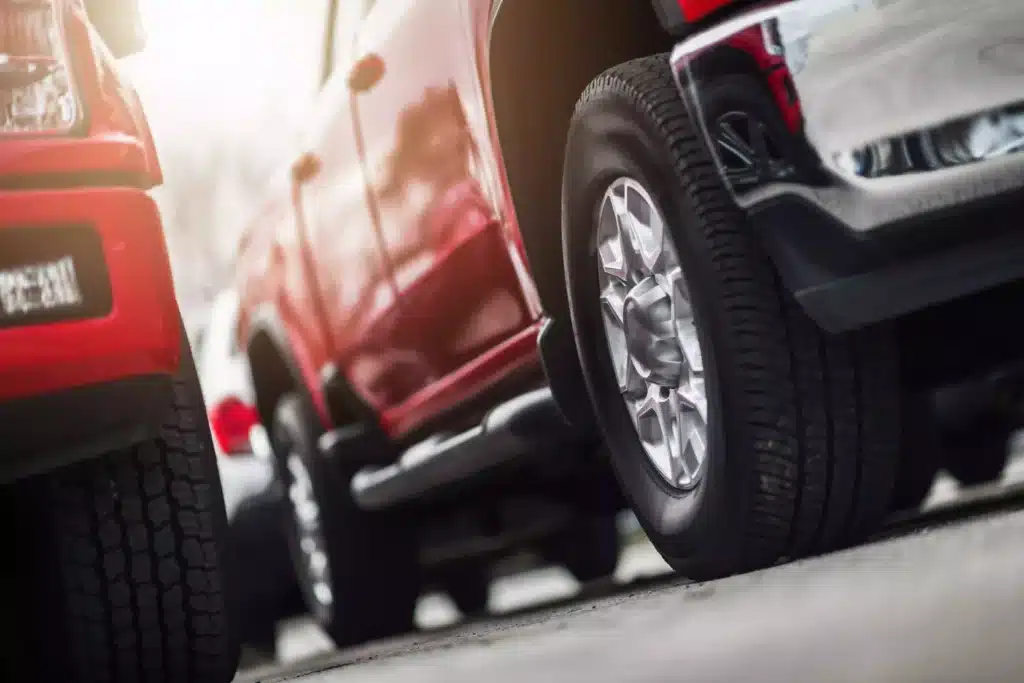

A Titan owner and a Frontier owner do not usually have much in common. One bought a full-size V8 pickup for towing, the other bought a mid-size truck that fits in a normal parking space, and the two rarely end up reading the same page about the same complaint.
They do here. Nissan put the same 9-speed automatic behind both trucks, and what came back from owners reads almost interchangeably: a shove when the truck steps down into a stop, a hesitation pulling away from a light, a jerk that arrives while you are simply holding a steady speed.
If a service advisor has already told you that this is just how the truck drives, it is worth knowing that owners of the other truck are hearing the same sentence at a different dealership.
So the two trucks belong on the same page after all. They share a gearbox and they share the complaint, and what really separates them is what Nissan wrote on their warranty paperwork.
The Shift Behavior Titan and Frontier Owners Keep Reporting
The complaint filed most often under Nissan Titan transmission problems is the downshift into a stop. The truck works down through the last gears and delivers a bump that pushes you forward in the seat, and unless you are firm on the brake it moves toward whatever is in front of it.
The 2021 Titan reports start early. One owner described that shove on a truck with roughly 800 miles on the odometer and said it had been doing it since the day he brought it home.
Frontier owners bring in something that looks like a different failure and traces back to the same transmission. One reported the gearbox dropping into neutral while driving, the truck losing motive power, and the check engine and transmission warning lights coming on together.
That truck was diagnosed with a sixth gear ratio fault and given a control module software update. The failure came back anyway, with the engine revving between shifts, at under 7,000 miles.
Between those two poles sits the bulk of what gets reported as Nissan Frontier transmission problems and their Titan equivalents. Lag when you ask for throttle, a clunk moving from park into drive, and a downshift hard enough to feel like contact from behind. One owner reported the jerking getting bad enough that holding a steady speed on the freeway turned into work, and said it had gone on close to a year.
Why the Same Gearbox Feels Different in a Titan and a Frontier
The 9-speed sits behind a 5.6-liter V8 in the Titan and a 3.8-liter V6 in the Frontier, in trucks separated by well over a thousand pounds. The fault owners describe is the same one, but the truck built around it changes what that fault does to you.
In the Titan, weight is the multiplier. A hard downshift in a full-size pickup that is loaded or pulling a trailer does not register as a rough shift, it registers as something in the driveline letting go, and the lurch moves real mass.
Titan owners also tend to meet it in the worst possible places, creeping through a parking lot or easing up behind a car at a light, where an unrequested surge forward has somewhere to go.
The Frontier turns the same fault into a different problem. Nissan Frontier transmission issues get described most often as hesitation, a truck that will not take off cleanly and needs a quarter throttle before it decides to move at all.
| Side by side | Nissan Titan | Nissan Frontier |
|---|---|---|
| The transmission | The nine speed automatic | The same nine speed automatic |
| How owners describe it | A hard shove coming down into a stop | A pause before the truck will move |
| Bumper to bumper coverage as sold | Five years or 100,000 miles on the 2020 trucks | Three years or 36,000 miles |
Neither version is the milder one. Nissan Titan transmission issues put the hazard in front of you, the Frontier version leaves you exposed to the traffic around you, and a service department can wave off both with one sentence.
What the Dealer Says When a Titan or Frontier Comes In
Nissan never issued a safety recall over this transmission. What it issued was service bulletin work, reprogramming for the transmission and engine control modules, handed to dealers as the answer for both trucks.
Owners who took that update report the behavior returning within days. The Frontier owner whose truck dropped into neutral had the software installed and was back with the same fault, and Titan owners describe the jerking and the lag reappearing just as fast.
The sentences owners hear are worth knowing in advance. After two visits, one owner was told this was simply “the nature of the transmission.” Another was told that “Nissan is fully aware of the issue and is working on a fix,” then waited most of a year.
One version of the visit unsettles owners more than the rest. Technicians have confirmed feeling the problem themselves, compared the truck against another new one on the lot, found it behaved identically, and treated the match as proof that nothing was wrong.
It is not proof of anything except how many of these trucks do it. Before your next appointment, check what Nissan has filed against your own truck through the federal recall lookup, which takes a VIN and tells you whether anything open applies.
How Far Nissan Warranty Coverage Goes on These Trucks
Here the two trucks stop being the same story. A 2020 Nissan Titan was sold with bumper to bumper coverage running five years or 100,000 miles, which Nissan promoted as the best warranty in the full-size truck class.
A Frontier bought the same week carries the ordinary terms instead: three years or 36,000 miles bumper to bumper, with the powertrain covered for five years or 60,000 miles.
The practical result is that two owners with an identical complaint can be standing in very different positions at 70,000 miles. That gap decides which one gets a free repair attempt and which one gets an estimate.
The gearbox did not leave with those trucks either. Nissan carried the 9-speed into the redesigned Frontier that is still on sale, which is why the same reports keep arriving from owners of much newer trucks.
A class action covering the 2020 and 2021 trucks has been working through a federal court in Tennessee since 2022, and by August 2026 owners had yet to see a settlement or a payment out of it. Waiting on it does not move your truck forward, and a California claim runs on a separate track.
Every truck described on this page is a 2020 or newer.
The Titan and Frontier Repair Files That Carry the Most Weight in California
California hands owners of both trucks the same tool. A problem the manufacturer warranty covers is where the Song-Beverly Consumer Warranty Act begins: it weighs how much of the truck’s usefulness, worth and safety that problem takes away, and then asks whether Nissan has been given a fair number of chances to correct it.
Surging at a crosswalk does not belong in the same box as a firm ride. A truck that lunges while you creep forward, or sits still while you are already committed across an intersection, is deciding things in traffic that the driver should be deciding.
The strongest files have less to do with drama than with consistency. The symptom is written up the same way on every repair order, so nobody can later argue that you reported three unrelated problems.
Visits where the technician found nothing still belong in the file. A shift fault that shows up under load or crawling through a parking lot rarely performs for a technician on the dealership’s own block, so count those trips alongside the rest instead of writing them off as visits that did not happen.
The software reprogramming visit counts too. Owners assume that because it was free and quick it does not register, when it is Nissan attempting a fix and dating the attempt for you.
Days matter as much as visits do. Time the truck spent sitting at the dealership adds up across the warranty period, and almost nobody thinks to total it.
Early reports are worth the most. The Titan owner who wrote up harsh shifting at 800 miles and the Frontier owner who reported a neutral drop before 7,000 miles both created something that no later argument can erase.
Leased trucks count, and so do trucks bought from a licensed California dealer with factory warranty still on them, which is where owners most often assume wrongly that they have no standing.
If you want the mechanics of it, the California lemon law guide sets out what a buyback returns and how a repair file gets measured against the standard.
Before you call anybody, add up the days your truck has spent at a dealership over this transmission and write that total at the top of the file. That total is the first thing worth putting in front of Lemon Law Help, and having it looked at costs nothing.
Nobody pays by the hour to learn what those dealership days are worth. Song-Beverly makes a losing manufacturer cover the winning owner’s legal fees, which is why claims like these are taken on contingency.
Reviewed by Roger Kirnos, Managing Attorney, California State Bar No. 283163.